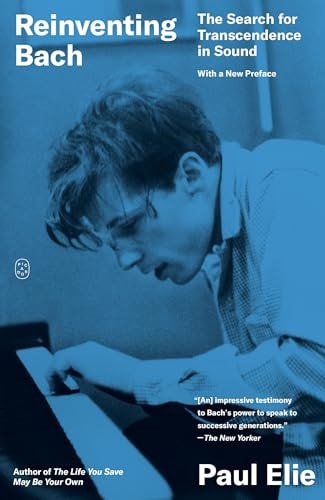
Reinventing Bach The Search for Transcendence in Sound
FINALIST FOR THE NATIONAL BOOK CRITICS CIRCLE AWARD FOR CRITICISM
One of the greatest musicians of all time, Johann Sebastian Bach was also a genius in the search for new sounds through technology—a pursuit as lively in his moment as it is in ours. A master of the pipe organ (the high-tech device of his era), Bach was constantly coming up with fresh and flexible approaches to keyboards, string instruments, and sacred choirs, such that his work is ceaselessly alive and adaptable three centuries later.
In Reinventing Bach, the composer’s life and work are the inspiration for a gripping contemporary story about the power of technology to sustain (rather than undermine) the arts. Like his classic The Life You Save May Be Your Own, Paul Elie’s second book is a vivid and intricate group portrait, a work of “epic sweep, like a novel made up of multiple strands” (The Economist). It is the story both of Bach’s practice of music as sacred invention, and of the amazing reinvigoration of the music by gifted artists using some of the most familiar inventions of our time: those of recording technology. We meet Albert Schweitzer making midnight recordings at the organ of a
London church via a mobile rig, Pablo Casals alone with a cello and a microphone at Abbey Road Studios on the eve of world war, and Leopold Stokowski persuading Walt Disney to feature the conductor’s own grand orchestrations of Bach in the animated film Fantasia. With the savant Glenn Gould hunkered over a piano in a state-of-the-art studio, the postwar reinvention of Bach is in full swing—and barrels onward with the Beatles, Switched-on Bach, and Gödel, Escher, Bach, right up to Yo-Yo Ma, the cellist who has cleared space for Bach in the digital realm.
With a new preface, Reinventing Bach conveys the music’s enduring influence and beauty—and evokes the ways recordings enable us to transcend time and space and enter a realm where an immortal composer, his master interpreters, and twenty-first-century listeners are brought together in a spiritualized encounter.
Original: $34.00
-65%$34.00
$11.90Product Information
Product Information
Shipping & Returns
Shipping & Returns
Description
FINALIST FOR THE NATIONAL BOOK CRITICS CIRCLE AWARD FOR CRITICISM
One of the greatest musicians of all time, Johann Sebastian Bach was also a genius in the search for new sounds through technology—a pursuit as lively in his moment as it is in ours. A master of the pipe organ (the high-tech device of his era), Bach was constantly coming up with fresh and flexible approaches to keyboards, string instruments, and sacred choirs, such that his work is ceaselessly alive and adaptable three centuries later.
In Reinventing Bach, the composer’s life and work are the inspiration for a gripping contemporary story about the power of technology to sustain (rather than undermine) the arts. Like his classic The Life You Save May Be Your Own, Paul Elie’s second book is a vivid and intricate group portrait, a work of “epic sweep, like a novel made up of multiple strands” (The Economist). It is the story both of Bach’s practice of music as sacred invention, and of the amazing reinvigoration of the music by gifted artists using some of the most familiar inventions of our time: those of recording technology. We meet Albert Schweitzer making midnight recordings at the organ of a
London church via a mobile rig, Pablo Casals alone with a cello and a microphone at Abbey Road Studios on the eve of world war, and Leopold Stokowski persuading Walt Disney to feature the conductor’s own grand orchestrations of Bach in the animated film Fantasia. With the savant Glenn Gould hunkered over a piano in a state-of-the-art studio, the postwar reinvention of Bach is in full swing—and barrels onward with the Beatles, Switched-on Bach, and Gödel, Escher, Bach, right up to Yo-Yo Ma, the cellist who has cleared space for Bach in the digital realm.
With a new preface, Reinventing Bach conveys the music’s enduring influence and beauty—and evokes the ways recordings enable us to transcend time and space and enter a realm where an immortal composer, his master interpreters, and twenty-first-century listeners are brought together in a spiritualized encounter.